

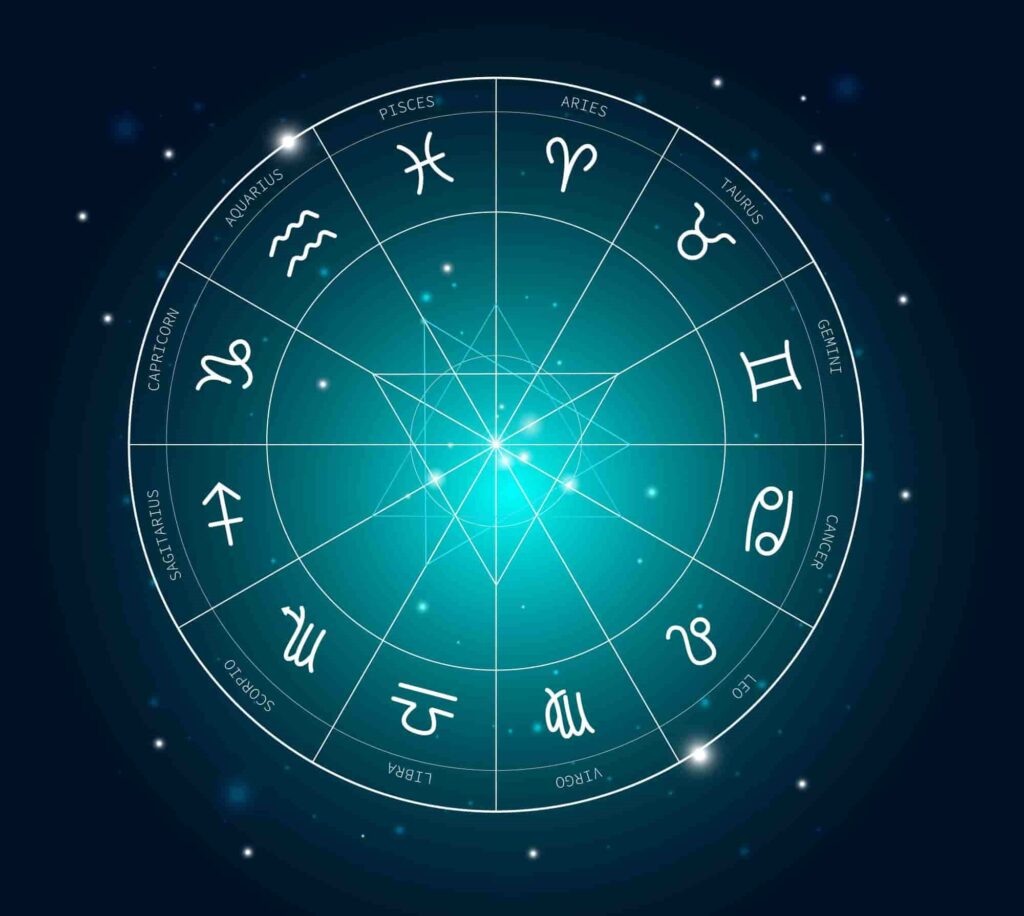
Astrology interprets the positions of celestial bodies at a specific moment, usually a birth, and reads meaning into them according to a given tradition’s rules. Not astronomy. Astronomy studies the same objects through physics and observation instead of interpretation.
In Vedic astrology the chart is called a Kundli. People bring it into questions about marriage, career, timing, or just wanting to understand themselves.
Astrology, Horoscope, Zodiac Sign, Birth Chart: Getting the Terms Straight
Astrology: The Bigger Picture
Astrology is the belief system that connects the positions of the sun, moon, and planets at a given moment to a person’s life or personality. It’s the system behind all of these terms – a horoscope, a birth chart, and a zodiac sign only carry meaning because astrology is the system behind them.
Vedic, Western, and Chinese astrology are all still astrology, even though each one calculates planetary positions and interprets them differently.
Zodiac Sign: One Part of the Chart
A zodiac sign is one of twelve equal divisions of the zodiac, each associated with a constellation. When someone asks, “What’s your sign?” they’re usually asking about your Sun sign – the sign the Sun was in at the time you were born. But that’s only one part of your birth chart.
Your chart contains many other planetary placements that astrologers consider when interpreting it. So knowing someone’s Sun sign doesn’t tell you everything about their astrology..
Horoscope: A General Reading
A horoscope is usually a short daily, weekly, or yearly forecast based on the current position of the planets and a person’s zodiac sign. This is the type of horoscope you usually see in newspapers or astrology apps. Since the same reading is meant for everyone with the same zodiac sign, it is generally quite broad and cannot account for a person’s individual birth details.
The word “horoscope” can also have a more technical meaning. In older astrological usage, it can refer to the chart made for a specific time and place. The exact meaning depends on how the word is being used.
Birth Chart (Kundli): Your Personal Map
A birth chart is a map of exactly where every planet and sign stood in the sky at the precise minute a person was born, calculated from their specific birth date, time, and location. In Vedic astrology, this chart is called a Kundli.
Unlike a horoscope, which has to generalize across everyone sharing a sign, a birth chart is built entirely from one person’s own details, which is why astrologers treat it as the real foundation for a reading rather than a simplified stand-in for one.
How These Terms Work Together
A zodiac sign is a single placement inside a birth chart, not the chart itself. A horoscope reads current planetary movement against either a Sun sign, for the popular daily version, or a full birth chart, for the detailed version astrologers actually work from. Astrology is the overall system that makes both possible.
Once that order is clear – astrology as the system, the birth chart as the detailed map, the zodiac sign as one piece of that map, and the horoscope as a reading drawn from either – the rest of how astrology works becomes much easier to follow.
How Does Astrology Work?
Astrology works by building a chart from someone’s exact date, time, and place of birth, then reading the planets, signs, and houses inside it. Birth time carries the most weight. The Ascendant and the houses come directly from it, and getting the time wrong by even a few minutes can throw off parts of the chart if it lands near a change in Ascendant.
Fix the three birth details and the Sun, Moon, and planets get positioned for that exact moment. Which signs they land in, which houses, how they sit against each other – all of it flows from that one starting map.
Birth-time accuracy matters even more once two charts get compared, the basis of Kundli matching by date of birth and time.
| Term | Meaning |
| Birth chart / Kundli | A chart calculated from a person’s birth details |
| Rashi | A zodiac sign |
| Bhava | A house in the chart |
| Graha | A celestial factor used in Vedic astrology — seven visible planetary bodies plus Rahu and Ketu |
| Nakshatra | One of 27 lunar divisions used alongside the zodiac |
| Dasha | A system of planetary periods used for timing |
Same thinness problem as the terms section – three subsections, one of them a single sentence. Here it is expanded properly, each type getting real treatment, with varied openings so it doesn’t fall back into the definition-first template.
What Are the Main Types of Astrology?
Astrology isn’t one method practiced everywhere the same way. Different traditions calculate the zodiac differently, use different tools, and interpret a chart by their own separate set of rules. Vedic and Western astrology are the two most widely practiced today, though several other systems exist alongside them.
Vedic Astrology (Jyotisha)
Vedic astrology, also called Jyotisha, developed in India and calculates positions using a sidereal zodiac – measured against the actual current position of the stars rather than the seasons. Because Earth’s axis slowly shifts over centuries, the sidereal zodiac and the seasonal one have drifted apart, and Vedic astrologers correct for that gap using a calculation called an ayanamsha.
Two tools set this tradition apart from the others. Nakshatras break the zodiac into 27 finer lunar divisions, layered on top of the twelve signs for more detailed reading, especially around the moon’s position. Dasha systems then lay planetary time periods across a person’s life, marking which planetary influence a Vedic astrologer would consider active during a given stretch of time. The most commonly used is the Vimshottari Dasha, a 120-year sequence of planetary periods that forms the backbone of most Vedic timing predictions.
Western Astrology
Western astrology takes a different starting point entirely, using the tropical zodiac, anchored to the seasonal equinoxes rather than the stars. Because tropical and sidereal calculations use different reference points, the same birth can land under a different sign depending on which system is doing the counting.
The tradition also carries a different emphasis. Where Vedic astrology leans toward timing and prediction through its Dasha systems, Western astrology tends to focus more on personality and psychological interpretation – the birth chart read as a map of temperament rather than a schedule of coming events. That said, this isn’t a hard rule; individual Western astrologers vary widely in how much weight they put on prediction versus personality.
Chinese Astrology
Chinese astrology works from an entirely different structure than either Vedic or Western systems. Instead of the sun’s path through twelve zodiac signs, it’s built around a twelve-year cycle of animal signs – the Rat, Ox, Tiger, and so on – combined with five elements (wood, fire, earth, metal, water) that rotate through those years.
A person’s animal sign comes from their birth year rather than the exact day or time, which makes it closer in structure to a yearly archetype than to a detailed individual chart.
Other Regional Traditions
Beyond these three, a number of smaller regional systems exist, each shaped by the culture it developed in – Mayan astrology built around a 260-day sacred calendar, and various Middle Eastern and European traditions that historically fed into what became modern Western astrology.
What Are the Main Parts of a Vedic Birth Chart?
A Kundli breaks down into a small number of fixed pieces: twelve houses, nine grahas, and the signs and Nakshatras that color both. The meanings below are traditional associations, and different schools of astrology read them with some variation.
The 12 Houses
| House | Associated With |
| 1st | Self, body, general disposition |
| 2nd | Wealth, family, speech |
| 3rd | Siblings, courage, communication |
| 4th | Home, mother or maternal influences, emotional foundations |
| 5th | Children, education, creativity |
| 6th | Health-related matters, obstacles, daily work |
| 7th | Marriage, partnerships, business |
| 8th | Transformation, longevity-related themes, sudden changes |
| 9th | Father or paternal influences, higher learning, fortune |
| 10th | Career, reputation, authority |
| 11th | Income, gains, social circle |
| 12th | Loss, isolation, spiritual release |
The 9 Grahas
| Graha | Associated With |
| Sun (Surya) | Self, authority, vitality |
| Moon (Chandra) | Mind, emotion, intuition |
| Mars (Mangal) | Energy, courage, conflict |
| Mercury (Budha) | Intellect, communication |
| Jupiter (Guru) | Wisdom, growth, fortune |
| Venus (Shukra) | Relationships, comfort |
| Saturn (Shani) | Discipline, delay, structure |
| Rahu | Ambition, obsession |
| Ketu | Detachment, past patterns |
Graha is what. Sign is how. House is where. Saturn in the 10th house, traditionally, means a career built slow, through discipline. Move it to the 4th house and now it’s about home, family weight, emotional load instead of a career at all.
What Do People Use Astrology For?
Relationships. Career direction. Education. Timing a decision. Sometimes just wanting to sit with a chart and think about your own life for a while. In Vedic astrology, Dasha periods get used to read whole stretches of time as leaning one way or another.
Marriage compatibility comes up constantly in India – comparing two charts before a wedding is still standard, sitting right alongside the usual family and financial conversations that happen regardless of astrology.
How Is Astrology Used for Marriage?
Kundli matching is the traditional comparison of two birth charts before marriage.
The core of it, the Ashtakoota system, often gets called Guna Milan: eight compatibility factors, 36 points on the table. Mars gets checked on its own too, under Mangal Dosha, and the exact rules shift depending on which school of astrology is doing the checking. Nadi is one of those eight Ashtakoota factors, tied to the Nakshatra linked to each person’s Moon. When it doesn’t line up, that’s Nadi Dosha.
These get weighed together. The full process, all eight factors including how Mangal Dosha gets assessed, is laid out in Kundli matching for marriage.
Can Astrology Predict the Future?
Within its own framework, yes – astrology does make predictions, and Vedic astrology in particular relies on Dasha periods to do it.
How Dasha-Based Predictions Work
Each Dasha marks a stretch of time during which a specific planet is considered the dominant influence in a person’s life. Astrologers read the general character of that planet into the events likely to unfold during its period.
- A Jupiter Dasha is often framed as a period favoring growth, learning, or good fortune
- A Saturn Dasha is often framed as a period calling for patience and discipline
- Each planet’s Dasha carries its own traditional theme, applied to whatever is happening in that stretch of a person’s life
Tendency, Not Certainty
These predictions are meant to describe general themes for a period, not a guaranteed sequence of events. That distinction is easy to lose sight of, since it’s often blurred in how astrology gets practiced and marketed.
Where the Line Gets Crossed
Some astrologers stay within that traditional framing and speak in terms of likely themes and general timing. Others go further, naming specific outcomes and exact dates with a certainty the tradition itself doesn’t really claim to offer.
- “This period may bring opportunities for career growth” – a reasonable claim within traditional Dasha-based astrology
- “You will get married on this exact date” or “this specific event will happen this year” – a much stronger claim, and one that deserves the same skepticism you’d apply to any confident, specific prediction from any source
Is Astrology Scientifically Proven?
No. It hasn’t been validated as a way to predict personality or future events. The test people cite most is Shawn Carlson’s – a physicist, double-blind study, 1985, published in Nature. Astrologers tried matching birth charts to the right personality profiles. Carlson’s finding: no better than chance.
Suitbert Ertel went back through Carlson’s own numbers in 2009 and found the original analysis had problems. Run correctly, two of Carlson’s tests actually showed astrologers doing better than chance predicts. Even Ertel didn’t call that proof. Just that Carlson’s rejection went further than his own data justified.
What Information Does an Astrologer Need From You?
Your date, time, and place of birth – an astrologer can’t get far without all three. Time in particular decides two of the most load-bearing parts of a chart, the Ascendant and the houses, so a guess or a rough estimate here throws off more than people expect.
Beyond the birth details, what actually helps most is being specific about why you’re there. A reading built for general life guidance draws on different parts of the chart than one built around a marriage decision, so naming the actual question upfront saves both of you time.
If the birth time genuinely isn’t known, some astrologers turn to rectification – working backward from major life events to narrow down a likely time. It’s a workaround, not a real substitute for a recorded one, and it introduces its own margin of error into the reading.
What Can Astrology Tell You – and What Can’t?
An astrological reading works within real limits. Knowing where those limits sit is what separates a grounded reading from an overblown one.
What Astrology Can Offer
- General tendencies and personality patterns drawn from the chart
- Broad themes for a period, based on Dasha or transit timing
- A framework for reflecting on decisions, relationships, or life direction
What Astrology Cannot Offer
- A guarantee of how another person will act or feel
- A prediction of whether an investment, business, or financial decision will succeed
- A medical diagnosis or health outcome
- A guarantee that a relationship or marriage will succeed or fail
A Practical Boundary Worth Remembering
Astrology is not a substitute for medical, legal, or financial advice. A reading can offer perspective and general guidance, but decisions involving health, money, or legal matters call for a qualified professional in that specific field, not an astrological chart.
Common Misconceptions About Astrology
Astrology and astronomy get mixed up constantly. One is science whereas the other reads the same sky through tradition instead of physics.
A single Dosha rarely decides anything by itself – weighed against the rest of the chart, not read alone.
Remedies are things practitioners believe help balance a chart. A belief inside the tradition. Not a proven effect.
Frequently Asked Questions
Q: What does horoscope actually mean?
A: Either the astrological chart itself, or – the everyday version – a short zodiac-based reading.
Q: Is a zodiac sign the same as a Kundli?
A: No. One sign versus the whole chart: nine grahas, twelve houses, all of it together.
Q: What is Vedic astrology actually based on?
A: A sidereal zodiac, measured against the stars. Western astrology goes the other way, measuring from the seasons.
Q: What’s the difference between a Rashi and a Nakshatra?
A: Rashi: one of 12 zodiac signs. Nakshatra: one of 27 finer lunar divisions, usually applied to the Moon’s position.
Q: What is a birth chart used for?
A: The base everything else builds from – planetary positions, against the signs and houses, at one moment in time. Different traditions ask different questions of that same base.
Q: Can astrology predict marriage?
A: Kundli matching checks compatibility before marriage. Whether the marriage actually works isn’t something it can confirm.
